
RALEIGH (July 9, 2026) – The $34 billion budget that Gov. Josh Stein signed Tuesday is a start, not a finish.
First, it’s a year overdue — North Carolina’s legislature was the only one in America that didn’t adopt a budget for 2025-26.
It includes an average raise of 8% for public school teachers, with starting teachers seeing raises of as much as 17%, increasing their base pay from $41,000 to $48,000.
But veteran teachers with 15 or more years of experience would only receive increases of 5.5% at the same time their health insurance costs are rising.
Their pay would remain flat from 15 to 24 years of experience. Teachers with 25 years’ experience would have base pay of $59,000. What’s more, none of the raises are retroactive to last year, as has been the practice with past overdue budgets.
How’s that for motivation? Is that any way to attract and keep the profession that creates all other professions?

“I thought I would be a career-long teacher,” Mark Cook, an English teacher at North Mecklenburg High School who just finished his 18th year, told The Charlotte Observer. “But realistically I don’t know how feasible that would be if this continues.
“Salaries are so far behind the cost of living,” he said.
Teachers and staff will receive one-time bonuses, though — nutrition and custodial staff will get bonuses of $1,750, teachers with 16 or more years of experience will be given $1,000 bonuses, while teachers with fewer years will receive $500.
Other state employees, including university and community college faculty and staff, would see raises of 3%.1
CERTAINLY an average raise of 8% for teachers sounds impressive, however inflation since October 2023 — the last time legislators managed to adopt a budget — amounted to 8.92%, per the U.S. Bureau of Labor Statistics.2
While this raise was well-deserved and appreciated, it doesn’t even keep up with inflation — especially for senior teachers or other state employees.
Before these raises were adopted, average teacher pay in North Carolina ranked 46th in the country, and the state ranked 50th among the states in funding effort — the share of its economy it devotes to K-12 public education.3
What an embarrassment for the state that ranks No. 1 in business.
So these raises are welcome, but don’t pat yourselves on the back just yet, legislators. There’s more work to be done.
As we said, the best way to view these raises is as a welcome start — but certainly not a finish, after years of neglect by North Carolina’s seemingly unaccountable General Assembly. The first rule of holes is to quit digging, and we appear to have done that.
OTHER points of contention in the budget:
TAXES: The state House deserves credit for slowing the Senate’s incessant tax-cut fervor, voicing doubts about scheduled tax reductions that could hamper the state’s ability to meet its obligations.
Economists have warned legislators that more aggressive tax cuts could force a revenue shortfall or budget deficit in coming years. Under the new budget, the personal income tax rate will drop from 3.99%to 3.49% in 2027, then to 2.49% in 2034 (rather than 2029 as it could under current law).4
VOUCHERS: The budget leaves in place a plan to expand use of taxpayer dollars for students to attend private schools to as much as $675 million in 2026-27.5
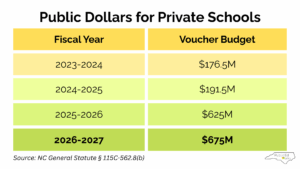
This use of public dollars to subsidize private schools — the vast majority of them religious schools — drains funds from public schools and contributes to a resegregation of our schools.
School choice has its place, but before you use tax dollars to fund private schools, fully fund public schools. North Carolina ranks 49th among the states in funding per pupil in public schools.6
The budget includes a provision that requires schools that accept vouchers to administer standardized tests, but it explicitly says the test results aren’t public records. This from the people who preach about accountability.
CHILDREN’S HOSPITAL: A major issue of contention between the House and Senate in budget negotiations was funding for NC Children’s, a joint effort between UNC Health and Duke Health to build a $3 billion children’s hospital in Apex that could produce 8,000 jobs. The budget allocates another $105 million to the project, in addition to $320 million provided in 2023.
UNC ENROLLMENT GROWTH: Unlike most universities across the country, the UNC System is adding students — yet it has seen no increase in state support for those additional students since 2023. UNC Chapel Hill Chancellor Lee Roberts explains the dilemma here:
The new budget allocates $153 million for enrollment growth across the UNC System.
NCINNOVATION: In early versions of the budget, lawmakers proposed clawing back some or all of the $500 million they granted in 2023 to NCInnovation. The nonprofit proposes to help commercialize research from the state’s public universities — especially those outside the Triangle. In the end, though, legislators left NCInnovation untouched.
1 https://www.charlotteobserver.com/news/local/education/article316364451.html.
2 https://www.bls.gov/data/inflation_calculator.htm.
3 https://edlawcenter.org/research/making-the-grade-2025/, Figure 3a. Funding Effort.
4 https://www.wral.com/news/nccapitol/north-carolina-budget-proposal-final-vote-july-2/.
5 https://publicedworks.org/2026/03/nc-voucher-funding-increases-for-2026-27/.
6 https://edlawcenter.org/research/making-the-grade-2025/, Figure 1a. Funding Level.
Leave a Reply